
🏆 Winner of Superpowers for Good - Viewers Choice Award

You deserve options when it comes to your health. Sign Up to unlock access to trusted hospitals, doctors, and travel assistance.
It's free and only takes a moment!
Nicole, CureValue
Every year we look at the marketplace data before the commentary. This year the numbers changed more than in any year since the exchanges opened in 2014, so this is a walk through what is known, what is projected, and what has not been published.
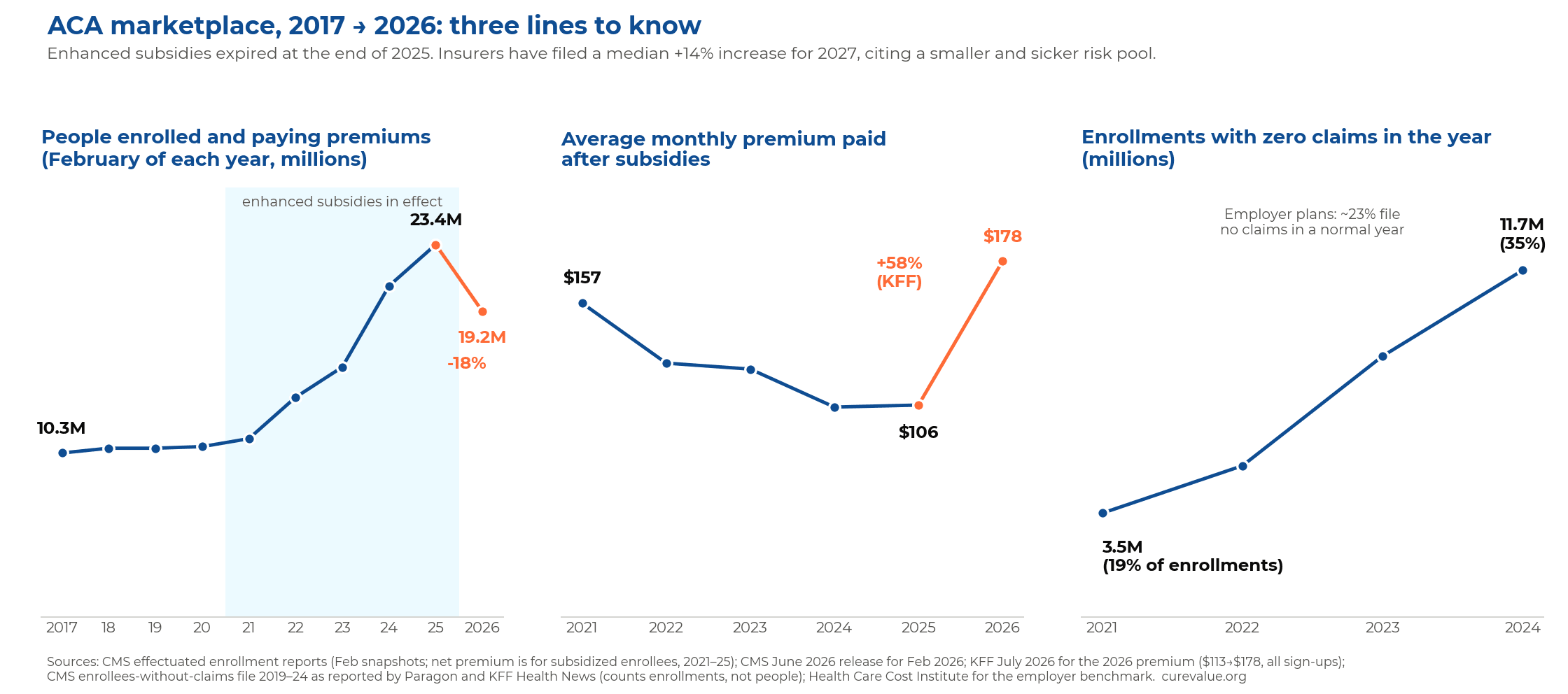
CMS released a file in August 2025 showing the share of individual-market enrollments with no medical claims in a year. It went from 19% in 2021 to 35% in 2024. In absolute terms, zero-claim enrollments went from 3.5 million to 11.7 million. Among enrollees in fully subsidized plans with the lowest cost sharing, the share reached about 40%.
Two things are needed to read that number correctly.
First, the file counts enrollments, not people. If someone switched plans mid-year, they appear twice, and the second record is likely to show zero claims. KFF, AHIP and the American Hospital Association have all pointed this out. Plan switching increased during the same years, partly because open enrollment windows got longer.
Second, not using insurance is normal. The Health Care Cost Institute found that 23% of people on employer-sponsored plans filed no claims in a typical year between 2018 and 2022. The marketplace population also got younger after 2021, and younger people use less care.
So the marketplace figure is higher than the employer benchmark, and some of that gap probably reflects enrollments that should not have happened. How much is the open question.
On September 22, CMS announced it is cancelling about 315,000 enrollments covering roughly 760,000 people, and reviewing another 419,000. The announcement described the affected group as people who were enrolled without their knowledge, did not meet eligibility rules, or "aren't using the program at all."
The data point that would settle a lot of this is simple. Of the enrollees with zero claims, how many paid a premium every month?
An enrollee who pays and never files a claim is not a cost to the program. They are the reason the program can pay for everyone else. An enrollee who pays nothing, files nothing, and does not know they are enrolled is a different case entirely. The government's June report from ASPE only broke out nonpayment for one group, people in $0 plans who were auto-renewed into a plan with a premium. That does not answer the question for the population being removed.
Until that number is published, "zero claims" tells us who did not go to the doctor. It does not tell us who was paying.
The enhanced premium tax credits that ran from 2021 through 2025 expired at the end of last year. The original subsidies still exist, but at lower levels, and anyone above 400% of the federal poverty level ($62,600 for a single person) now pays full price.
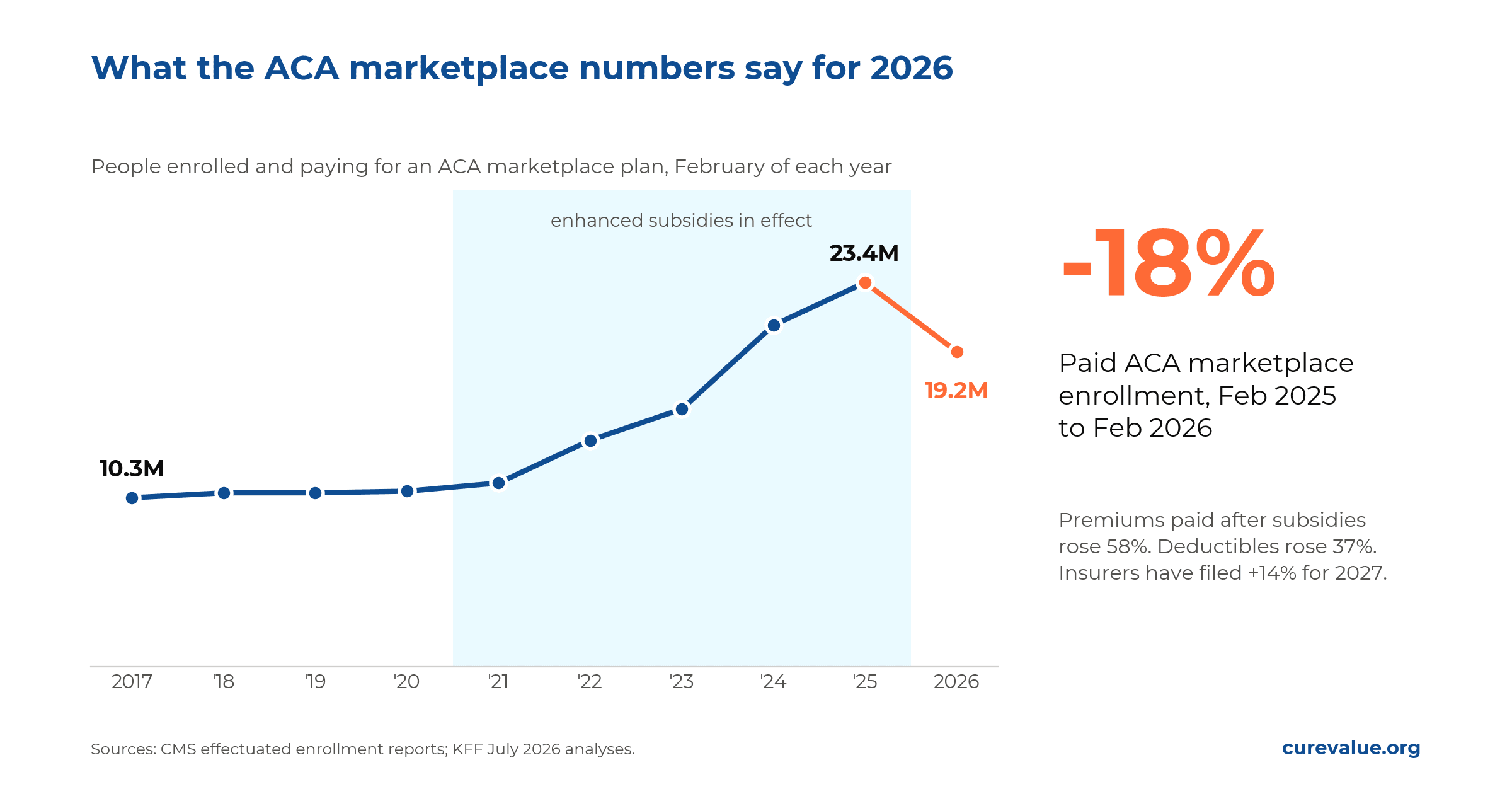
Paid enrollment each February, from the CMS effectuated enrollment reports:
| Year | Enrolled and paying (Feb) |
|---|---|
| 2017 | 10.3M |
| 2018 | 10.6M |
| 2019 | 10.6M |
| 2020 | 10.7M |
| 2021 | 11.2M |
| 2022 | 13.8M |
| 2023 | 15.7M |
| 2024 | 20.8M |
| 2025 | 23.4M |
| 2026 | 19.2M |
The market was flat at about 10.5 million for four years, more than doubled during the enhanced-subsidy years, and dropped 18% this February. That is the steepest one-year decline since the exchanges opened.
The rest of the 2026 picture, mostly from KFF's July analyses of CMS data:
The deductible number is the one most people miss. It rose because people traded down to bronze plans to keep the monthly cost manageable. They are paying more per month for coverage that pays out later.
Preliminary 2027 rate filings across 16 states and DC show a median requested increase of 14%. Twenty insurers asked for more than 20%. Last year the median request was 18% and finalized at 20%.
Insurers give two reasons. Medical costs are rising about 10%, above the recent 8% trend. And the people who left in 2026 were healthier on average than the people who stayed. Insurers estimate that shift added about 4 points to 2026 premiums and expect another 4 points in 2027. CMS's own 2027 payment rule projects a further 1.2M to 2M enrollment decline from added verification steps.
This is the mechanism to watch. When healthier people leave, the average cost per remaining enrollee goes up, premiums follow, and the next renewal window pushes out the next group of healthier people. It is not a prediction. It is what the 2026 filings already priced in.
Most of the debate is about the program. Very little of it is about the person holding a bronze plan with a $3,786 deductible who needs a knee replacement, IVF, dental implants or a cardiac procedure this year.
For that person, a few things are true at once:
At CureValue we see this in our own data. People are not looking for a way around insurance. They are looking for a way to get a specific procedure done at a price they can plan for, and they want to see the options side by side with the cost, the accreditation and the outcomes.
The marketplace data for 2026 says the number of people in that position grew by millions. The 2027 filings say it will grow again.