
By Lyka Antonio – CureValue Customer Success Manager
I spent last week looking at hospital price data from RAND, the research group that has been tracking what private insurers pay hospitals since 2017. I wanted to know something simple. If you need surgery in America, how much does the state you live in change the bill?
The answer is a lot more than I expected, and the reason isn't what hospitals usually say it is.
RAND takes real claims from employer health plans and reprices each one using the government's own payment formula for the same procedure at the same hospital. That formula already adjusts for local wages and how sick the patient was. So it works as a baseline. If a hospital lands at 2x, it charged private patients double what the baseline says that procedure should cost in that town.
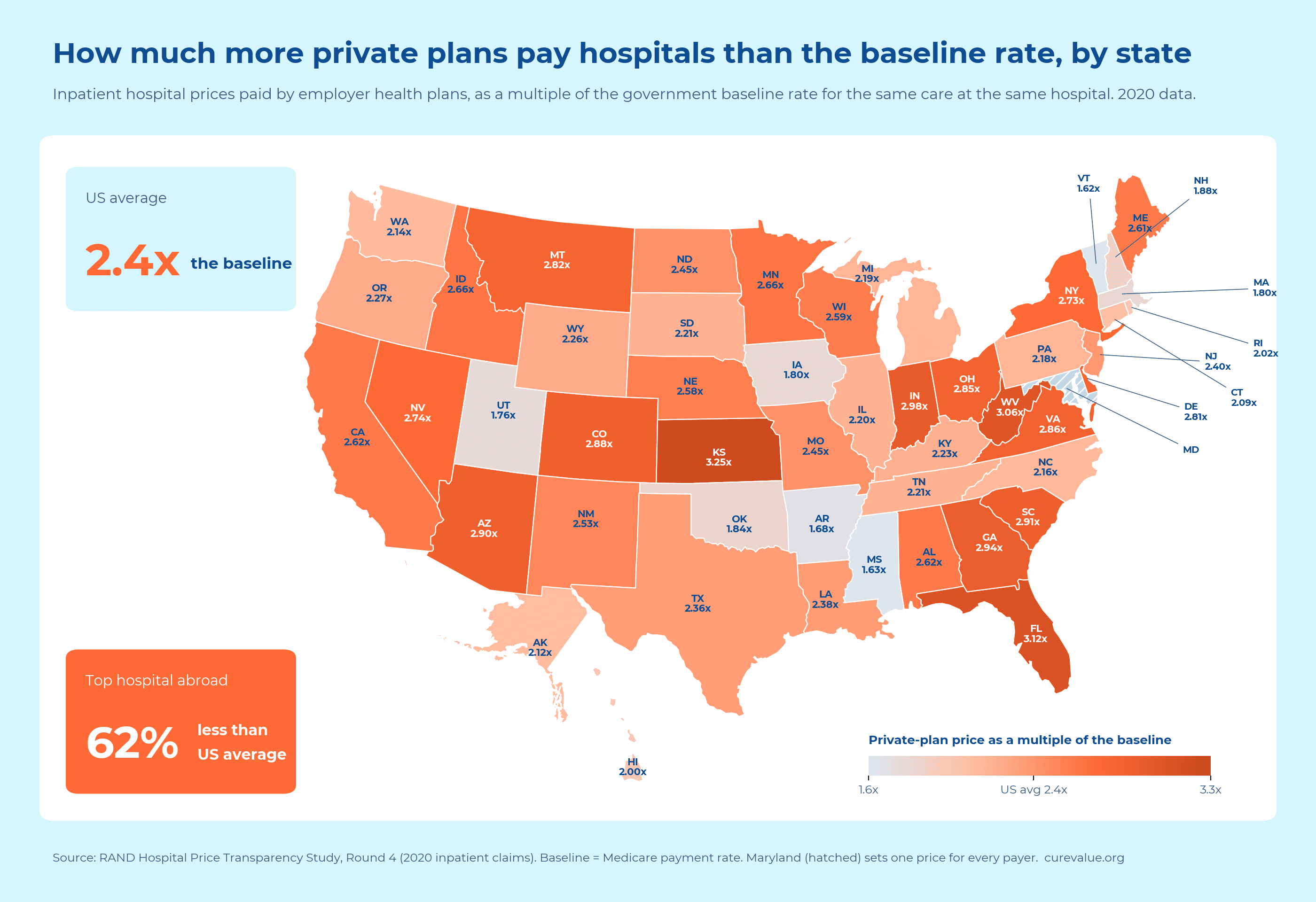
Nationally, hospitals charge private patients about 2.4x the baseline. That average hides a huge spread.
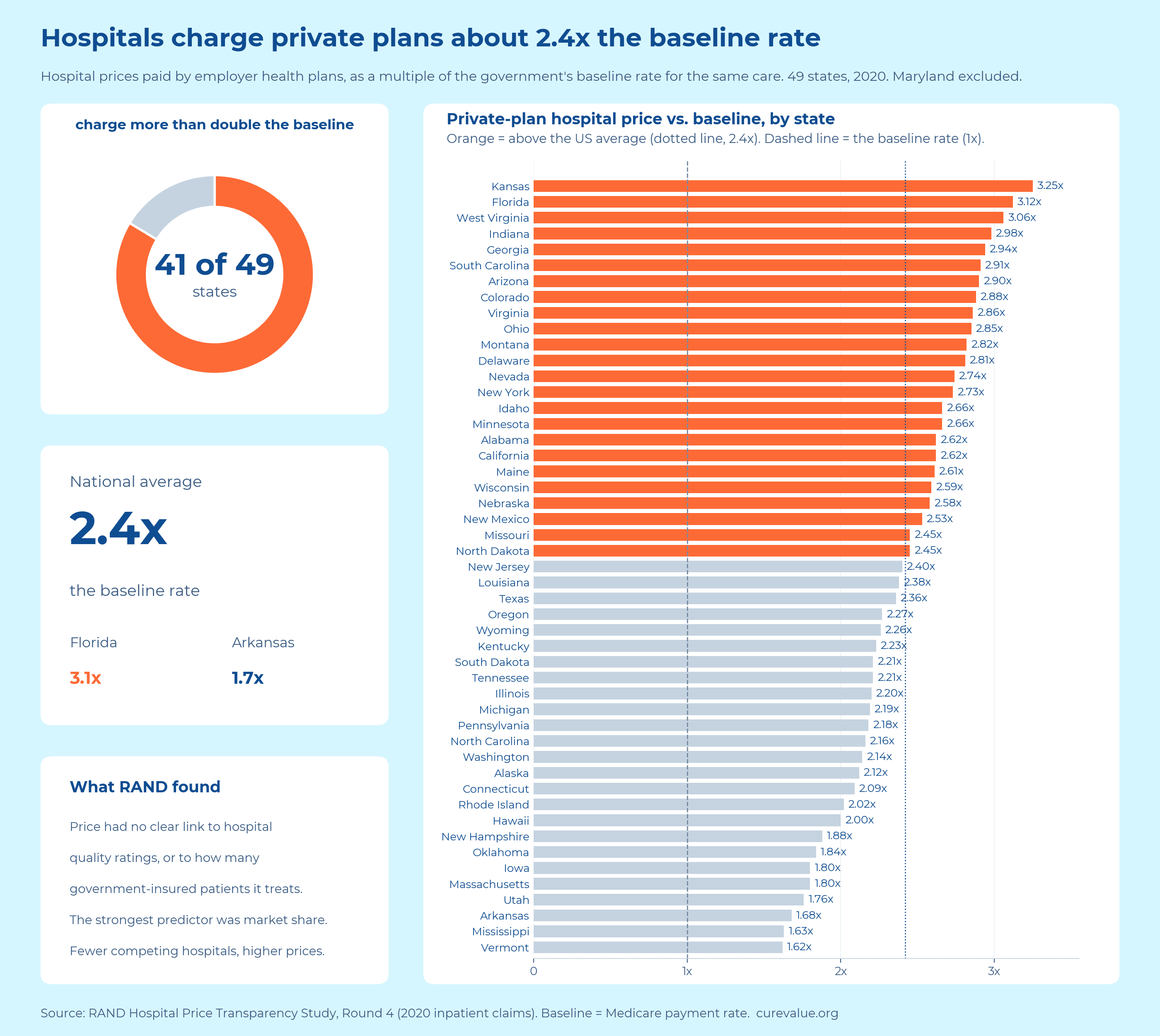
Based on 2020 data, Arkansas hospitals charged about 1.7x and Florida hospitals charged about 3.1x. In RAND's newest data (2022), Florida moved to the top of the country at 3.5x. Same procedures, same baseline, nearly double the markup.
It's easy to read this as a problem for people paying cash. It isn't. If you're on an employer plan, you pay these prices in three places.
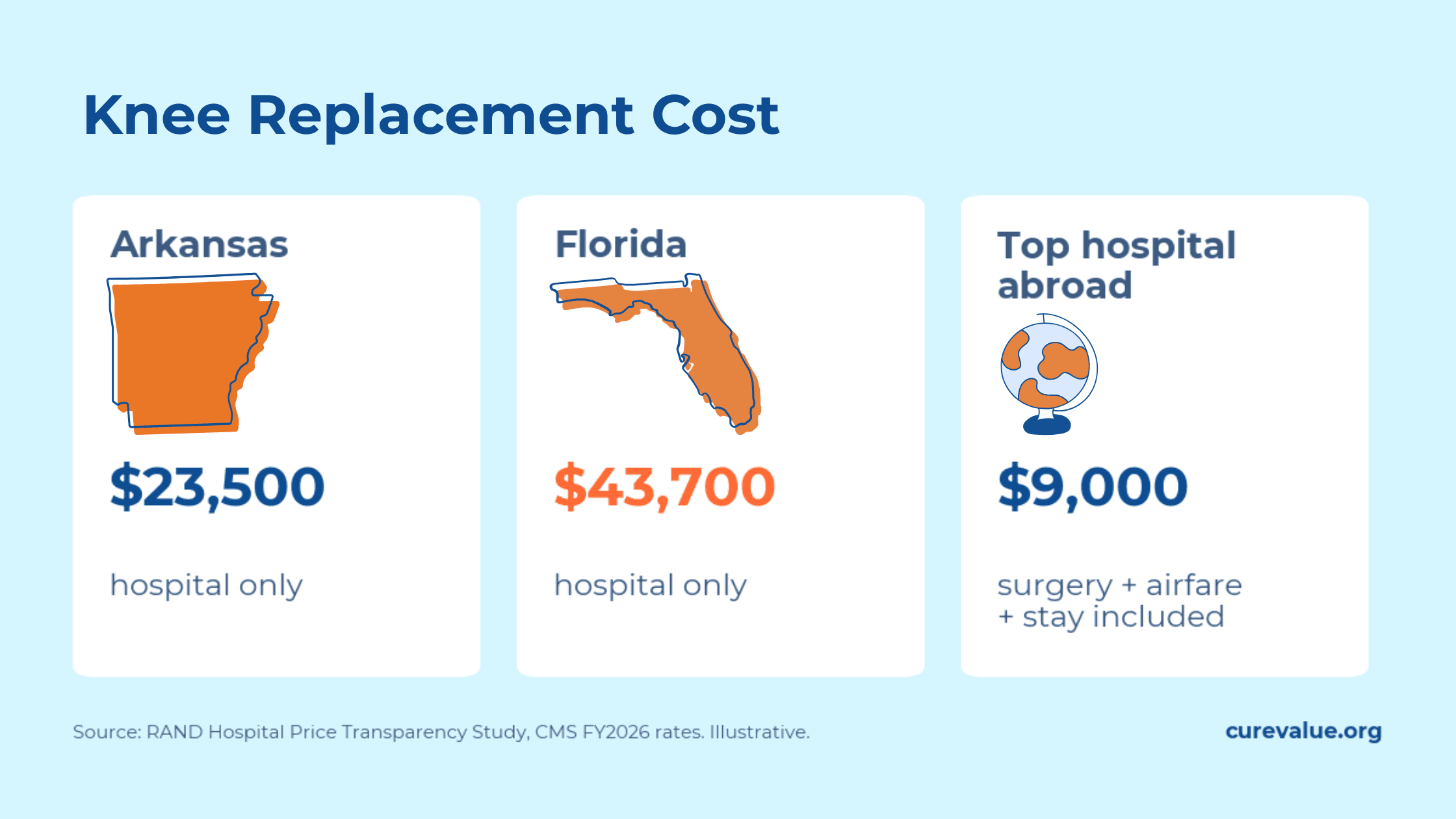
Most employer plans have a deductible around $1,900 for an individual and close to $4,000 for a family, then 20% coinsurance until you hit the out-of-pocket max. Take a knee replacement where the hospital collects roughly $23,500 in Arkansas and $43,700 in Florida. Your 20% share is about $4,700 in one state and $8,700 in the other. Same insurance card, same surgery, double the check.
The average employer family premium is now about $27,000 a year, and the employee's share is about $6,850 out of paychecks. Insurers set premiums off what hospitals charge. Higher markups in a state mean higher premiums in that state.
About two thirds of covered workers are on self-funded plans, which means the insurer processes the claim but your employer pays it. Money spent on a $43,700 knee is money that didn't go into raises. Economists have been measuring this for decades. Hospital price growth shows up as flat wages.
Percentages are abstract, so I translated two common procedures into what the hospital roughly collects. Two things to know about these figures. The US numbers are the hospital's portion only, so the surgeon and anesthesia are billed on top. And they apply the state markups to this year's baseline rate, so treat them as illustrations, not quotes.
The baseline hospital payment for a standard joint replacement is about $14,000 this year.
| Where | What you pay |
|---|---|
| Arkansas | about $23,500, hospital only |
| US average | about $33,900, hospital only |
| Florida | about $43,700, hospital only |
| Top hospital abroad | about $9,000, surgery, airfare, and stay included |
The baseline hospital payment for bariatric surgery without complications is about $11,000.
| Where | What you pay |
|---|---|
| Arkansas | about $18,500, hospital only |
| US average | about $26,600, hospital only |
| Florida | about $34,300, hospital only |
| Top hospital abroad | about $6,000, surgery, airfare, and stay included |
The abroad figures cover the surgeon, the hospital stay, the flight, and usually a few nights of recovery lodging. The US figures don't cover any of that beyond the hospital.
The obvious guess is that Florida hospitals are better, or that they're covering losses from patients who can't pay. RAND checked both.
Price had no clear relationship to quality ratings. Hospitals with more government-insured patients didn't charge private patients more. The one thing that reliably predicted a high price was how many competing hospitals were left in the area. When a hospital system buys its last competitor, prices go up, and nothing about the care changes.
That's worth sitting with whether you're on a high-deductible plan or paying cash. The price you're quoted isn't a measure of what you're getting. It's a measure of how much choice you had.
CureValue makes it clear which providers clear this bar, and every listing shows the accreditation right on the page, so you're not taking anyone's word for it.
Here's the same comparison for the procedures people most often travel for. US figures are typical cash or negotiated prices. Abroad figures are typical all-in packages at accredited hospitals.
| Procedure | Typical US price | Typical abroad | Common destinations |
|---|---|---|---|
| Dental implant (single) | $4,500 | $1,500 | Mexico, Costa Rica, Turkey |
| Hair transplant | $10,000 | $2,500 | Turkey |
| IVF (one cycle) | $15,000 | $5,500 | Czech Republic, Spain, Mexico |
| Hip replacement | $40,000 | $12,000 | Thailand, India |
| Gastric bypass | $25,000 | $6,000 | Mexico |
| Cataract surgery (per eye) | $4,000 | $1,800 | India, Mexico |
| LASIK (both eyes) | $2,500 | $1,200 | Turkey, Mexico |
| Heart bypass | $123,000 | $7,900 to $12,500 | India |
| Rhinoplasty | $8,000 | $3,000 | Colombia, Turkey, South Korea |
If you have a planned procedure coming, three things are worth knowing:
That's what we built CureValue to help you find. Every provider on the platform is checked for quality and transparency, and every listing shows the local price next to the US price so you can see the gap before you talk to anyone.
You don't have to leave the country to use this. Even if you never book a flight, knowing that hospitals in one state charge nearly double what hospitals in another do for the same surgery changes how you read your own bill.
Source for state price ratios: RAND Corporation, Hospital Price Transparency Study, Round 4 (2020 inpatient claims) and Round 5.1 (2022). Baseline dollar figures use the federal fiscal year 2026 inpatient payment rates published by CMS and are approximate. Premium and deductible figures are from the KFF 2025 Employer Health Benefits Survey. Abroad prices are typical all-in packages from accredited providers and vary by hospital and case.
You deserve options when it comes to your health. Sign Up to unlock access to trusted hospitals, doctors, and travel assistance.
It's free and only takes a moment!