

You deserve options when it comes to your health. Sign Up to unlock access to trusted hospitals, doctors, and travel assistance.
It's free and only takes a moment!
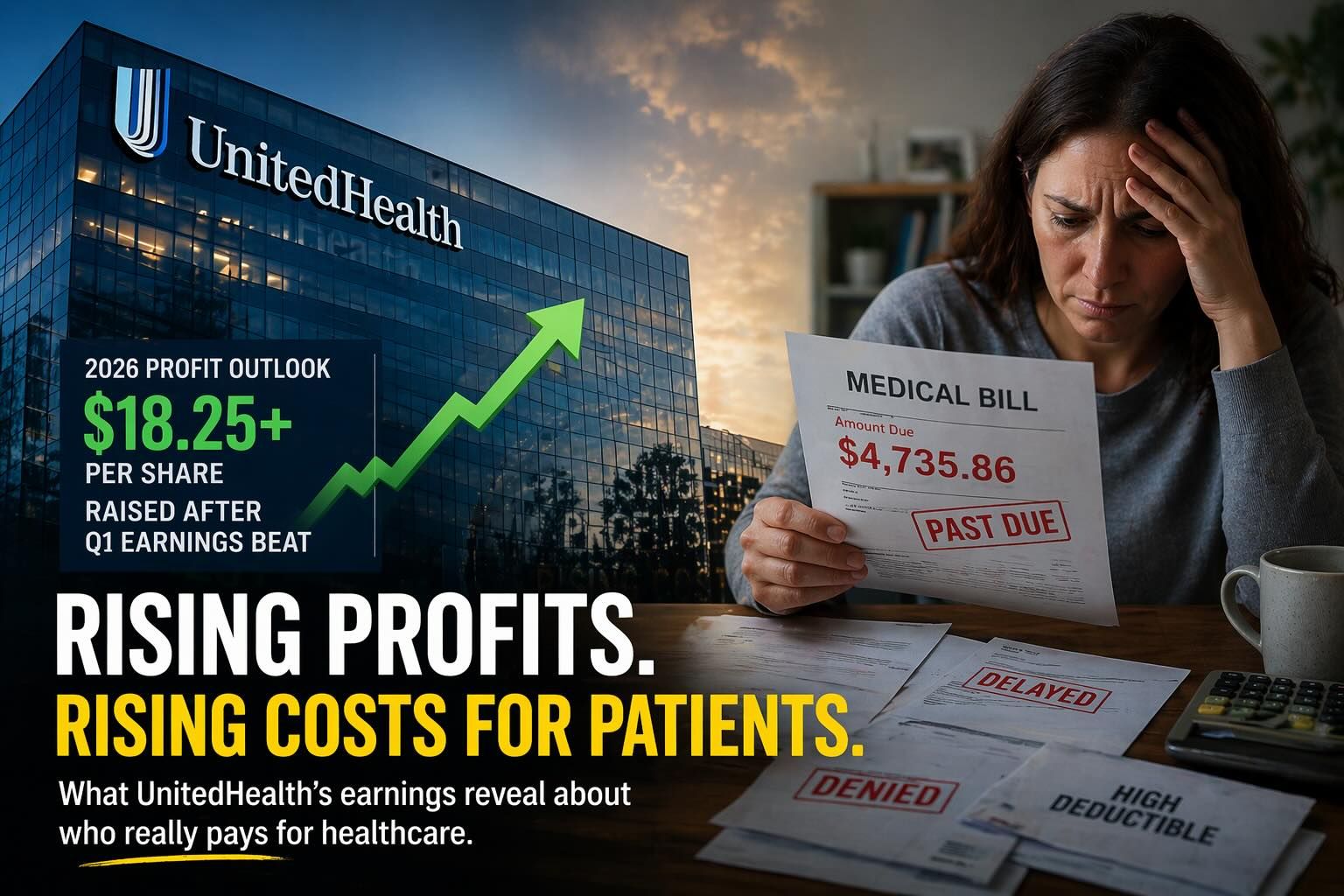
UnitedHealth Group recently reported first quarter 2026 earnings that exceeded expectations. The company not only beat Wall Street estimates but also raised its full year profit outlook to more than $18.25 per share.
On paper, it was a strong performance. Revenue climbed past $111 billion for the quarter, and net income reached $6.28 billion.
At the same time, millions of Americans continue to face rising deductibles, delayed procedures, and growing out of pocket costs.
So the question becomes:
What exactly is improving and for whom?
One of the most important but least understood metrics in health insurance is the medical benefit ratio.
This number represents the percentage of premium dollars that are actually spent on patient care.
In this case, UnitedHealth Group reported a medical benefit ratio of 83.9%, down from 84.8% a year earlier.
At first glance, that may not seem significant. But it carries a deeper implication.
A lower ratio means a smaller portion of what patients pay in premiums is being used for their actual care.
In other words, more of that money is being retained within the system.
For many Americans, health insurance does not feel like protection. It feels like a series of hurdles.
Patients today are navigating:
The financial experience of healthcare has become increasingly unpredictable.
Coverage does not always translate into clarity.
And clarity is often what patients need most when making critical health decisions.
The structure of the system creates a subtle but powerful dynamic.
Health insurers are rewarded for:
They are not directly rewarded for:
The system is optimized for financial efficiency, not patient visibility.
This does not mean any single company is acting in isolation. It reflects how the broader system has evolved over time.
Consider how decisions are made in other areas of life.
You can compare flights across multiple airlines in seconds.
You can evaluate hotels, read reviews, and understand pricing instantly.
Now compare that to healthcare.
Most patients cannot:
The challenge is not just cost. It is the inability to see clearly.
Without visibility, patients are forced to make decisions under uncertainty.
As costs rise and complexity increases, patient behavior is beginning to change.
More people are:
This does not mean patients are abandoning the system.
But it does mean they are no longer relying on it blindly.
Awareness is becoming the first step toward better decision making.
The conversation around healthcare is often framed around rising costs.
But cost is only part of the issue.
The larger challenge is lack of clarity.
Patients are expected to make some of the most important decisions of their lives without:
As healthcare becomes more complex and globally interconnected, the need for accessible, comparable information will only grow.
The real question is no longer what care costs. It is whether patients can actually see their options before they need them.
If you have ever tried to compare what a procedure actually costs across providers, you already know how fragmented and difficult that process can be.
Understanding your options is no longer a luxury. It is becoming a necessity.