
Published August 2026
There's a number in this month's Economic Liberties report on prior authorization that doesn't get the attention the big ones do. 79% of physicians say their patients sometimes abandon treatment because of the authorization process. Not because the treatment stopped being necessary. Because the fight to get it approved outlasted the person's ability to keep fighting.
This post is for the person at that point. Not the policy argument, we've written that here. This is the practical question nobody answers once the denial sticks: what are your actual options now?
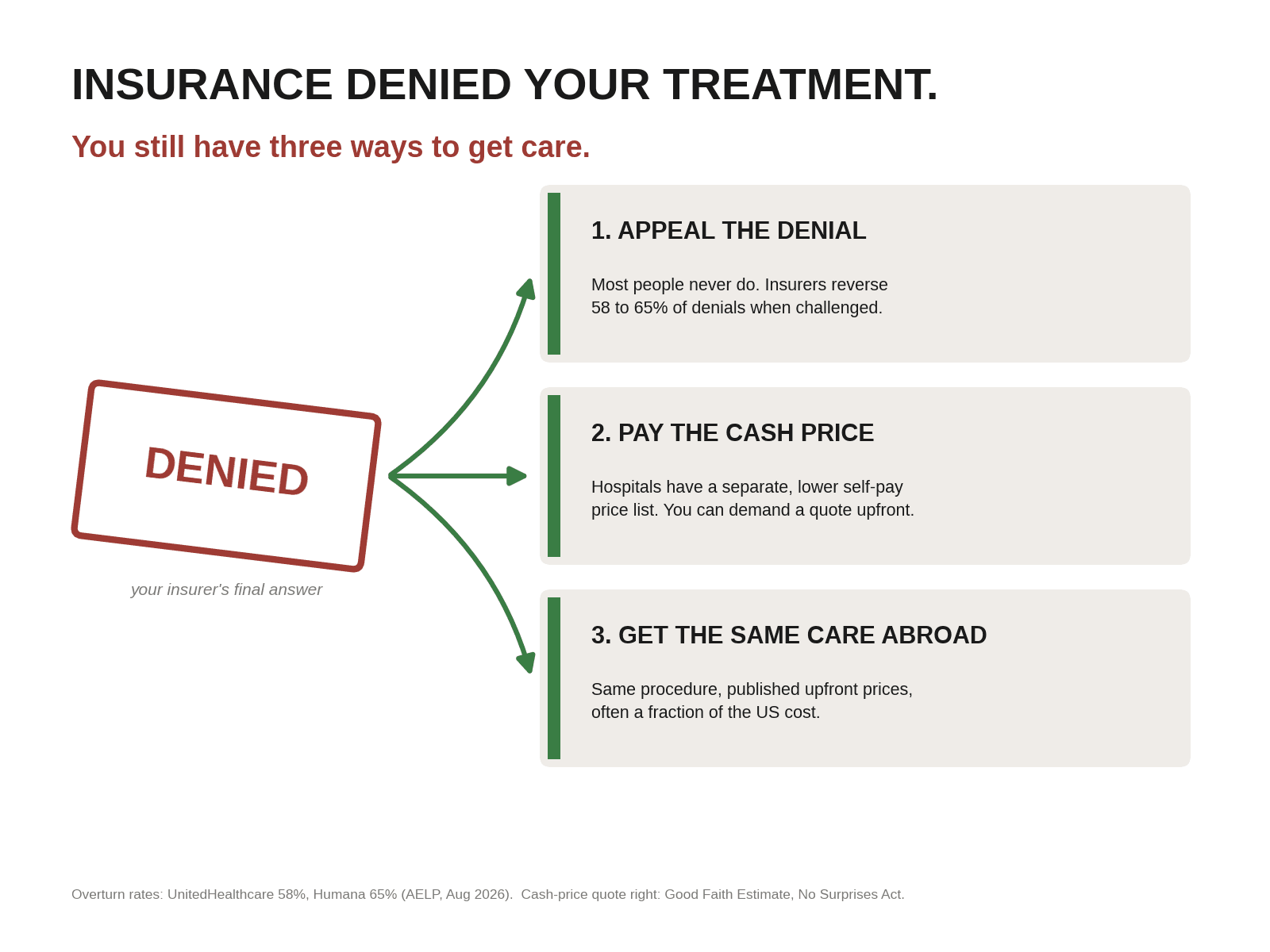
If you haven't appealed yet, appeal. The numbers are on your side and almost nobody uses them. UnitedHealthcare overturns 58% of appealed denials. Humana overturns 65%. New brand-name drugs get denied 70% of the time on first request, and a year later that falls to 24%, same drug, same patient. The first no is frequently not a medical judgment. It's a filter for who pushes back.
Fewer than half of denied patients ever appeal. Your doctor's office has fought this exact denial before, ask them for a letter of medical necessity, and ask whether a peer-to-peer review has happened yet. Many denials fold at that step alone.
This is the part nobody tells you. The moment your insurer's no becomes final, insurance is no longer part of the price of that treatment. You're paying out of pocket either way. That changes which prices apply to you, and most people never learn that a second set of prices exists.
Ask the hospital or clinic for their self-pay or cash price, not the billed rate. These are often dramatically lower than the number on the bill, and sometimes lower than what your insurer would have "negotiated." Since 2022, the Good Faith Estimate law requires providers to give self-pay patients a real price quote before scheduled care. If you're paying cash, you have a legal right to a number in advance. Use it.
For expensive drugs, check the manufacturer's copay assistance program and foundations like HealthWell and the PAN Foundation before paying list price. These programs exist precisely because the sticker prices are indefensible, and they routinely cover thousands of dollars.
Here's a fact that reframes the whole situation. A hip replacement at a major teaching hospital in Belgium costs an uninsured foreign patient about 8,000 euros, all in, at published prices, no negotiation, no surprise bills. The same procedure in a US hospital typically runs $30,000 to $40,000. The implant inside you can be the identical device from the identical manufacturer.
That gap is not because Belgian surgeons are worse. It's because the price you're quoted in the US has to feed every intermediary between you and the operating room, and the price abroad doesn't. We've mapped those intermediaries, all 25 categories of them, here. When people ask why the same care costs a fifth as much elsewhere, the honest answer is that the medicine was never the expensive part. The wall was.
For a denied treatment, the comparison that matters is simple: the cash price you can actually get quoted in the US, versus the total cost abroad including travel, versus the cost of not getting treated at all. For some situations, care that can't wait, care that needs local follow-up, staying home wins clearly. For a lot of plannable procedures, the math surprises people. Your family's out-of-pocket maximum this year is $21,200. The median American household has about $8,000 in liquid savings. For many families, the "covered" path costs more cash than the flight-included path.
We built CureValue for exactly this decision. It gives you a realistic estimate of what your treatment typically costs in the US, and real prices from vetted providers abroad, before you commit to anything. You can run your specific treatment through the instant cost estimator and see the numbers side by side in a few minutes, which is less time than you've spent on hold this week.
Two things we think matter about how it works. You pay for it directly, so there is no insurer in the loop and nobody in the chain is paid to tell you no. And it's optional, it's a route around the wall for the care where a route exists, not another layer added to it.
The system is designed to make giving up feel like your only option. It isn't. It's just the only option nobody profits from telling you about.
Sources: American Economic Liberties Project, "Ban Prior Authorization" (August 2026). CMS Good Faith Estimate requirements under the No Surprises Act. KFF Employer Health Benefits Survey. Federal Reserve Survey of Consumer Finances. Published self-pay pricing, UZ Leuven, Belgium.
You deserve options when it comes to your health. Sign Up to unlock access to trusted hospitals, doctors, and travel assistance.
It's free and only takes a moment!