
The cost of healthcare in the U.S. is a persistent issue, with Americans paying more for less compared to other wealthy nations. In 2024, the U.S. spent 18% of its GDP on healthcare, nearly double the OECD average, yet outcomes remain worse, with lower life expectancy and higher rates of skipped care due to cost. The problem? A convoluted system of intermediaries that inflates costs without improving care.
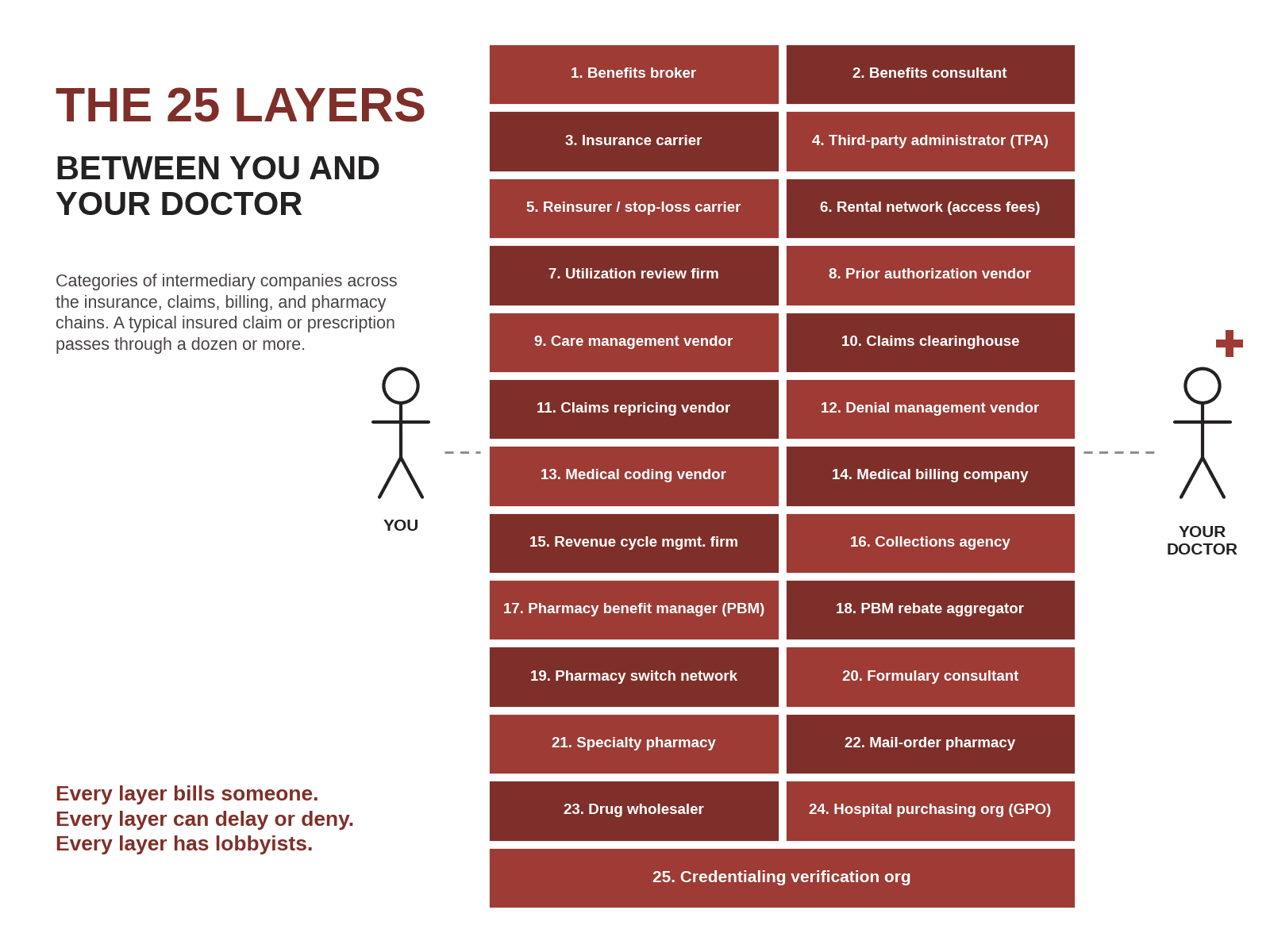
When you see a doctor in the U.S., you’re also interacting with a 25-layer supply chain, each layer adding a cost before care reaches you. The doctor and care are real, but the system in between creates confusion, frustration, and skyrocketing prices for patients.
The precise number of layers isn't exact. It can shift depending on how you count and classify each piece of the process. But what matters isn't the exact figure, it's the pattern: layer after layer inserted between you and your care, each one extracting value without delivering it.
Some of the most common include:
None of these layers treat patients. They exist to manage processes and generate profit.
These layers didn't appear overnight. Each one was introduced as a fix for the problem before it.
Prior authorization was supposed to stop fraud. Pharmacy Benefit Managers were supposed to control drug prices. Re-pricers were supposed to catch over billing. Every new intermediary arrived with a justification and a promise.
What happened instead? Each layer became an industry. And every industry that forms around a problem has a financial incentive to keep that problem alive. The fraud didn't disappear, it just moved. Drug prices didn't fall, they were obscured. Over billing wasn't eliminated, it was renegotiated, with a cut taken along the way.
That is how a system ends up this complex. Not through a single catastrophic decision, but through decades of incremental additions, each one logical in isolation, each one compounding the dysfunction beneath it.
The complexity described above is not a byproduct of a sophisticated system. It is the mechanism by which cost is generated, obscured, and transferred to you. Here is what that looks like in practice.
A total hip replacement in the U.S. costs $30,000 to $40,000 out of pocket. That number is stated as fact, but what does it actually include? Surgery? Anesthesia? The implant itself? Post-operative care? When the bill arrives, it rarely tells you. You get a number. You are expected to pay it.
The same procedure at a top European teaching hospital costs under $10,000. Same surgery. Same implant, manufactured by the same company, to the same specification.
So why the gap? The implant didn't change. The surgical technique didn't change. The only thing that changed was the system surrounding the procedure, the layers of intermediaries, the opaque pricing agreements, the rebate structures, and the administrative overhead that exist in the U.S. and nowhere else. That is not a coincidence. That is the cost of complexity, and you are the one paying it.
Insurance companies say doctors charge too much. Doctors say insurers reimburse too little. Pharmaceutical companies blame pharmacy benefit managers for inflating costs at the distribution layer. PBMs turn around and blame drug manufacturers for setting prices no one can justify. Hospitals blame administrative overhead. Administrators blame compliance requirements. Compliance requirements point back to the insurers.
Every layer has a villain. Conveniently, that villain is always someone else.
This isn't a misunderstanding, it's a structure. When accountability is diffuse, no single actor has to answer for the total cost you pay. Each one optimizes for its own margin and passes the remainder down the chain, until it lands on you, in the form of a bill you didn't expect, for a price you were never shown in advance.
The system isn't broken by accident. It is held together by the shared interest of every participant in keeping it exactly as it is.
Reform has been promised for decades. It has not arrived, not because solutions are unknown, but because the people profiting from the current structure have every incentive to prevent change.
Other countries have demonstrated that alternatives work. Single-payer systems, nonprofit insurers, and regulated pricing models exist, function, and produce measurably better outcomes at lower cost. The U.S. has studied them, debated them, and repeatedly failed to implement them. It is not for lack of evidence, but because every layer of the current system employs lobbyists whose sole function is to ensure that layer survives.
Insurance companies, hospital networks, pharmacy benefit managers, and device manufacturers each maintain dedicated political infrastructure to protect their margins. Reform does not fail because it is unworkable. It fails because it is unwelcome by those with the resources to stop it.
The system does not merely resist reform, it absorbs it. When price transparency laws passed, hospitals were required to publish their rates. Most did, in formats deliberately engineered to be unreadable. The fines for non-compliance were calculated in advance and treated as an operating expense.
When AI entered healthcare administration, it was deployed not to reduce costs or accelerate approvals, but to deny claims faster and at greater scale. Every tool that enters this system gets optimized to serve the system's existing incentives. That is not a flaw in implementation. That is the design working exactly as intended.
Systemic reform to the U.S. healthcare system is a slow and uncertain process, and it’s unlikely to arrive in time to address your immediate medical needs. For individuals facing urgent care decisions, it's crucial to explore alternative solutions that can provide relief now.
The U.S. system is not the only option. It just wants you to think it is.
Internationally accredited hospitals across Mexico, South Korea, Spain, Belgium, and beyond perform the same procedures, with the same equipment, the same clinical standards, and often the same specialist training, at a fraction of U.S. prices. Not because quality is compromised. Because the billing infrastructure inflating your domestic quote does not exist there.
Fixed, transparent pricing is the norm. You see the number before you commit, not after you recover.
This is not a fringe movement. It is a growing, data-supported response to a system that has priced its own citizens out of care.
Is the provider legitimate? How do you verify credentials across borders? What happens if something goes wrong? These are not irrational fears, they are the right questions to ask. The problem is that most people ask them and then stop there, assuming the answers are too hard to find.
CureValue exists to find them for you. We verify every provider credential, surface transparent pricing before you make any decision, and calculate your real savings inclusive of travel costs, so you are comparing actual numbers, not assumptions. No provider pays for a higher ranking on our platform. No commission changes what you see. You get the full picture, and you decide.
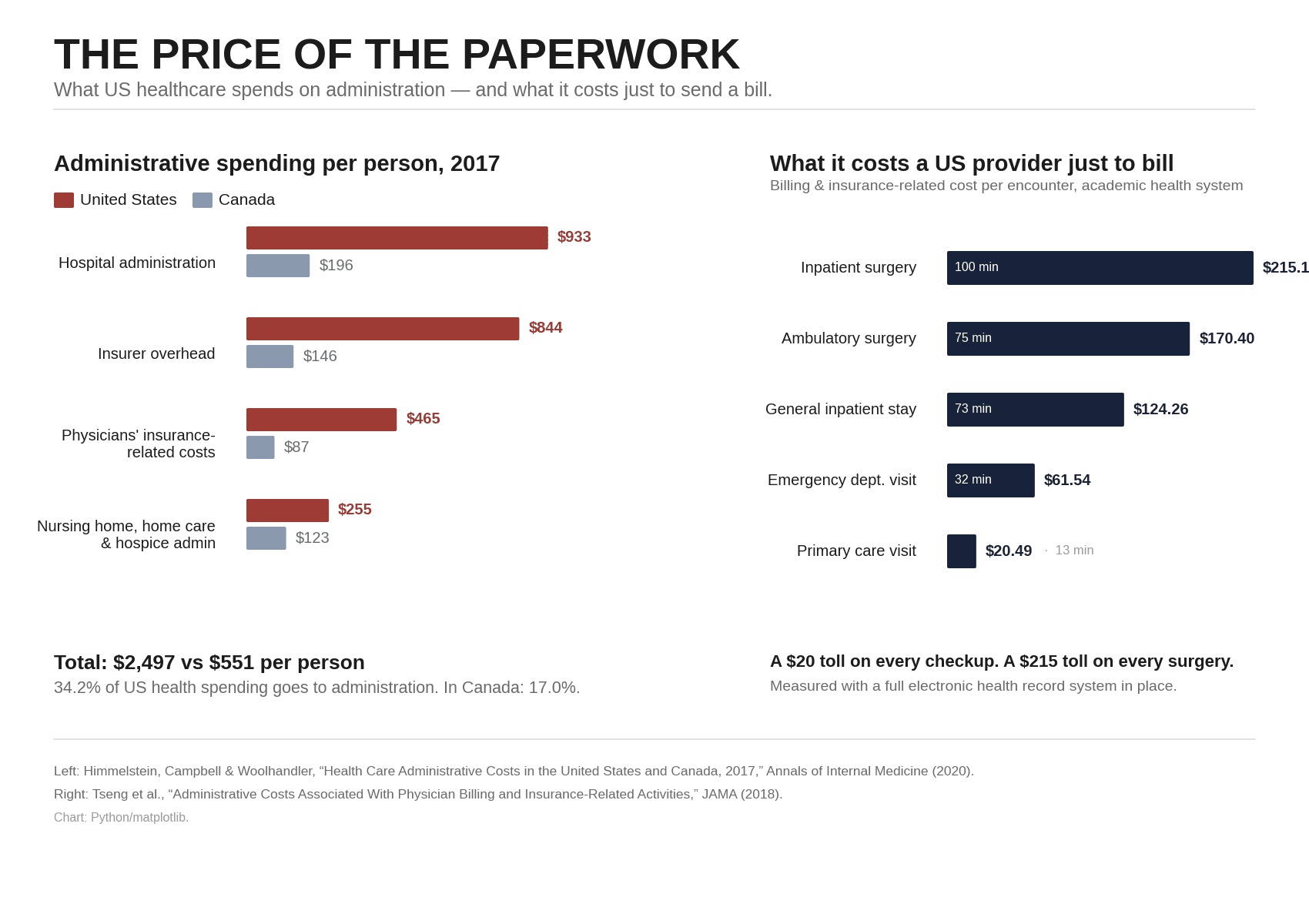
Himmelstein DU, Campbell T, Woolhandler S. "Health Care Administrative Costs in the United States and Canada, 2017." Annals of Internal Medicine, 2020. US administrative spending of $2,497 per person vs $551 in Canada. https://www.acpjournals.org/doi/10.7326/M19-2818
Tseng P, Kaplan RS, Richman BD, Shah MA, Schulman KA. "Administrative Costs Associated With Physician Billing and Insurance-Related Activities at an Academic Health Care System." JAMA, 2018. Billing costs of $20 per primary care visit to $215 per inpatient surgery, measured at one academic health system. https://jamanetwork.com/journals/jama/fullarticle/2673148
CMS Office of the Actuary, National Health Expenditure Data. US health spending reached $5.3 trillion in 2024, 18.0% of GDP. https://www.cms.gov/data-research/statistics-trends-and-reports/national-health-expenditure-data/historical
Commonwealth Fund. "Mirror, Mirror 2024: A Portrait of the Failing U.S. Health System." US ranks last of 10 wealthy nations overall despite spending the most. https://www.commonwealthfund.org/publications/fund-reports/2024/sep/mirror-mirror-2024
KFF, Drug Channels Institute, and CAQH Index data on intermediary categories across the insurance, claims, and pharmacy chains.
You can't dismantle the 25-layer system overnight, but you don't have to pay for it either. See what your procedure costs without the wall.
Get your Instant EstimateYou deserve options when it comes to your health. Sign Up to unlock access to trusted hospitals, doctors, and travel assistance.
It's free and only takes a moment!